~$ what the heck is an uwu-space
Posted on May 26th, 2026. | Est. reading time: 9 minutes
Tags: HackspaceTechnicalCommunityInfrastructure
about one and a half years ago, the idea for a space emerged at GPN21 (June 2023), and grew in the void left by the somewhat non existent ccc chapter that used to exist in Zurich (CCC-ZH).
we gained a lot of interest locally due to being somewhat detached from the CCC operationally, but still adherent to the Unvereinbarkeitserklärung (declaration of incompatibility) of the CCC, which enforces a certain alignment that we consider would be best for our members.
and so, in November of 2025, a dozen or more creatures from the Zurich area congregated in a room in the Bitwäscherei - a collective of hackspaces in Zurich - to found a primarily queer hackspace, named “UwU-Space” and elected its committee, of which i am one of the members.
building something that would hold up with time
one of the major issues with building an association is that one needs to have several capabilities that aren’t evident from the onset, for example being able to receive payments for membership, or to be able to hold a membership roster, or to have the ability to do some form of accounting.
this led us to the first adventure in the list, which was to apply for a bank account.
the process wasn’t entirely as easy as we’d hoped, because bank bureaucracy didn’t really like our light-handed approach to the KYC process, but after a few clarifications and back-and-forths, we got there in the end.
at the same time, we wanted to have some set of services available to members, which they could sign-in to using some form of social sign-on system. i’ll go into more depth about this when i talk about the infrastructure
the sweet smell of democracy (and the ways we messed up)
the committee was made up of 6 members (myself included), and we originally kicked off under the mistaken assumption that we could all agree and get along, because we’d spent so much time together building this up. as could be expected, this very much didn’t happen.
the disagreements were initially mild and of procedural nature, but as soon as some of the decisions veered into the interpersonal realm, we realized that this was not a tenable situation, and moved to a “the aye’s have it” democracy type decision making scheme. we can’t make everyone happy, but we can at least try to drive consensus.
we also later were told that our decisions lacked transparency, so we started holding plenary sessions to talk to members and made sure that there were avenues in order to collect feedback or for them to outright voice their complaints.
infrastructure
the first step in our grand plan to host services for our members involved deciding what we would actually end up hosting ourselves, and where to host it.
initially, the “where” seemed pretty self-evident, as our friend memdmp / 7222e800 was hosting a machine in the Bitwäscherei - nicknamed “crunchy” - which was a hypervisor self-written by mem. despite the overall performance of the machine being acceptable, the cursedness in how we were meant to access it for maintenance made it a bit complicated, and we quickly realized we may need to shove a bit of infra into the server room ourselves.
thankfully, i had a half-depth 1U server sitting around unused in my office, so after adding an SSD and making sure it was running fine, i brought it to BW in order for it to get added to the server room and wired. this machine later ended up being referred to as uwu-main.
at that point, we were forced to address another problem, which was that the Bitwäscherei’s network does not support IPv4 addressing, only IPv6. on paper, that doesn’t sound too terrible, until one realizes that an not-insignificant portion of container registries are IPv4 only (and at that time so was my home network, until i decided to get on a somewhat stupidly long technical phone call with my ISP to talk about Microtik configuration only for them to realize the docs had a Microtik file which had an incorrect v6 pool size for our exact usecase and give us the correct value).
so how does on magically add IPv4 to an IPv6 network?
good question, thanks so much for asking.
in my exact use case, i decided to go with the “jump host” technique, which involves getting a very cheap VPS, making that the DNS target for all of the relevant domains, and running caddy in order to route traffic over a homebrew wireguard solution which not only bridged the jumphost but forced all of the IPv4 traffic through the jumphost.
this ends up looking a bit like this (the jumphost is uwu-jump and our VM on crunchy is uwu-crunchy):
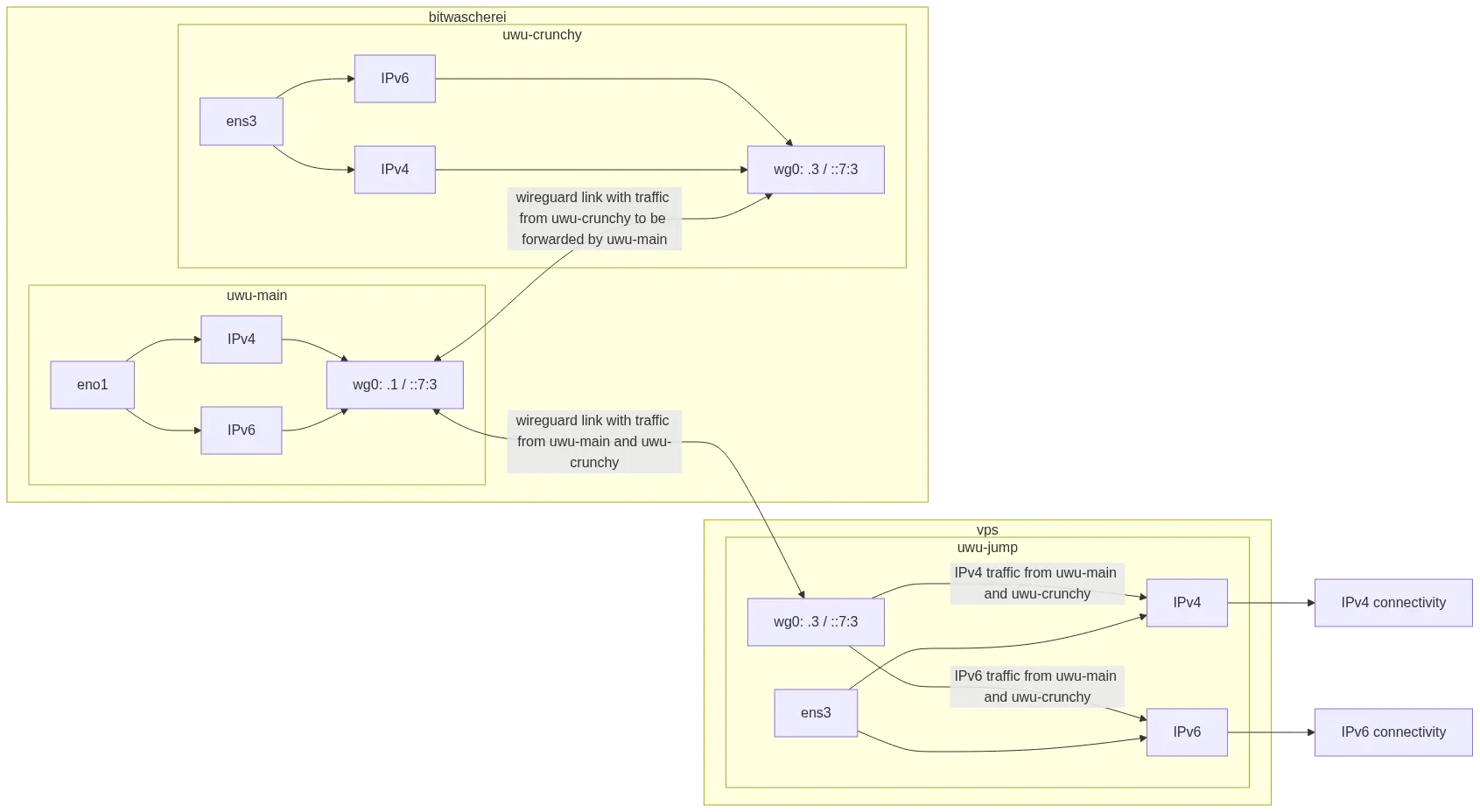
now, a reader familiar with wireguard configs would know that wireguard doesn’t natively do all of these funky force-traffic through an interface shenanigans, so how did we go about it?
for that, i decided to use iptables, applied post-tunnel activation or pre-tunnel deactivation, which in code looks something like this (on uwu-main):
[Interface]Address = [REDACTED]:1::7:1/112, 10.0.0.1/24ListenPort = 51820PrivateKey = ${PRIVATE_KEY_uwu-main}
# Enable forwardingPostUp = sysctl -w net.ipv4.ip_forward=1PostUp = sysctl -w net.ipv6.conf.all.forwarding=1PostUp = iptables -A FORWARD -i wg0 -o wg0 -j ACCEPTPostUp = ip6tables -A FORWARD -i wg0 -o wg0 -j ACCEPT
# Route IPv4 through uwu-jumpPostUp = ip route add default via 10.0.0.2 dev wg0 table 200PostUp = ip rule add from 10.0.0.1 table 200 priority 100PostUp = iptables -t nat -A POSTROUTING -o wg0 -j MASQUERADE
PostDown = iptables -D FORWARD -i wg0 -o wg0 -j ACCEPTPostDown = ip6tables -D FORWARD -i wg0 -o wg0 -j ACCEPTPostDown = ip route del default via 10.0.0.2 dev wg0 table 200PostDown = ip rule del from 10.0.0.1 table 200 priority 100PostDown = iptables -t nat -D POSTROUTING -o wg0 -j MASQUERADE
DNS = 9.9.9.9, 2a02:168:475d:1::53
# uwu-jump[Peer]PublicKey = ${PUBLIC_KEY_uwu-jump}PresharedKey = ${PRESHARED_KEY_uwu-main-jump}AllowedIPs = [REDACTED]:1::7:2/128, 10.0.0.2/32, 0.0.0.0/0PersistentKeepalive = 25
# uwu-crunchy[Peer]PublicKey = ${PUBLIC_KEY_uwu-crunchy}PresharedKey = ${PRESHARED_KEY_uwu-main-crunchy}AllowedIPs = [REDACTED]:1::7:3/128, 10.0.0.3/32PersistentKeepalive = 25after a while we sunset uwu-crunchy but this is still the operative flow.
at some point we also had to modify caddy with layer 4 capabilities, as it can’t natively handle certain types of layer 4 traffic because caddy doesn’t natively have the ability to handle raw TCP and UDP streams, which is something we ended up needing.
for this, we compiled caddy-l4 (on GitHub) and deployed it as a standin replacement for caddy.
services
as mentioned earlier, we wanted to have some set of services available to our members, so we started off by deploying SSO, which involved deploying Authentik as i was already familiar with it from running my own infrastructure at home. this would then gate access to a number of services.
selecting these services would usually try and avoid services which have the SSO tax baked in, as that is an anti-pattern in our opinion and contrary to the principles of open-source software. you can read more about the sso tax on the related directory here.
so far we’re also pretty happy with the consistency of our uptime, which is a point of pride.
despite knowing that self-hosting email is… a pain (to the point a common meme in the community is “no friend lets another friend host email”), we decided we needed some more-resolutely formal way of official communication… hence email. using a 3rd party service provider could have been an option, but this falls short of our intended goal of running all of this as lean as possible.
so we ended up self-hosting Stalwart, which is what initially prompted the aforementioned need for us to be able to have L4 capabilities with caddy.
the only other major pain is syncing the certificates issued by caddy on uwu-jump to uwu-main, but for that we have a systemd path trigger, which looks like this:
[Unit]Description=copy certs from caddy to uwu-main:[path-on-uwu-main]/cert
[Path]PathModified=[path-to]/mail.uwu-space.ch.json
[Install]WantedBy=multi-user.targetand we have a systemd job which looks like this:
[Unit]Description=copy certs from caddy to uwu-main:[PATH_ON_UWU_MAIN]/cert
[Service]Type=oneshotExecStart=sleep 1ExecStart=scp -i [PATH_TO_SSH_KEY] -o "IdentitiesOnly=yes" [PATH_TO_ACME_FOLDER]/[CRT_FILE].crt [USER]@uwu-main:[PATH_ON_UWU_MAIN]/cert/[CRT_FILE].pemExecStart=scp -i [PATH_TO_SSH_KEY] -o "IdentitiesOnly=yes" [PATH_TO_ACME_FOLDER]/[KEY_FILE].key [USER]@uwu-main:[PATH_ON_UWU_MAIN]/cert/[KEY_FILE].pemExecStart=scp -i [PATH_TO_SSH_KEY] -o "IdentitiesOnly=yes" [PATH_TO_ACME_FOLDER]/[JSON_FILE].json [USER]@uwu-main:[PATH_ON_UWU_MAIN]/cert/[JSON_FILE].jsonExecStart=ssh -i [PATH_TO_SSH_KEY] -o "IdentitiesOnly=yes" [USER]@uwu-main 'chown [USER]:[USER] [PATH_ON_UWU_MAIN]/cert/*'ExecStart=ssh -i [PATH_TO_SSH_KEY] -o "IdentitiesOnly=yes" [USER]@uwu-main 'chmod 0775 [PATH_ON_UWU_MAIN]/cert/*'
[Install]WantedBy=multi-user.targetthis isn’t ideal and doesn’t yet trigger the reload target on stalwart, but gets 90% of the way there.
git
we also decided to host our own git instance, which would be the location for the code behind uwu-space's website and the location for whatever projects would be made at the hackspace.
this git instance runs ForgeJo, which is something i’ve also had experience hosting for myself and some friends.
the one caveat here that we know of is that because the git instance is on uwu-main, but the traffic goes via uwu-jump, we had to either put the L4 traffic passthrough in caddy, or do what i’d done on my own infrastructure, which was punch a tunnel using wireguard which is statefully maintained on both sides, the config of which is this:
[Unit]Description=Setup a secure tunnel to %IAfter=network.target
[Service]ExecStart=/usr/bin/ssh -v -o PubkeyAuthentication=yes -F /etc/default/tunnel/secure-tunnel.config -NT %i
# Restart every >2 seconds to avoid StartLimitInterval failureRestartSec=5Restart=always
[Install]WantedBy=multi-user.targetHost git-v4 HostName 10.0.0.1 User uwu IdentityFile [PATH_TO_FORWARDING_KEY] LocalForward 0.0.0.0:222 10.0.0.1:222 ServerAliveInterval 25 GatewayPorts yes ExitOnForwardFailure yes
Host git-v6 HostName [REDACTED]:1::7:1 User uwu IdentityFile [PATH_TO_FORWARDING_KEY] LocalForward [::]:222 [[REDACTED]:1::7:1]:222 ServerAliveInterval 25 GatewayPorts yes ExitOnForwardFailure yesmediawiki
because we have projects, we naturally need a place to document them.
what better place than some wiki instance, which would of course benefit from our sso integration?
this may have involved me spending way too much time dealing with the LocalSettings.php file, but in the end we got it running! (at wiki.uwu-space.ch).
the website
the website is a hugo pre-rendered website served from a container that is built and tagged by a CI job in forgejo, and gives people just the necessary information about the hackspace, where to find the wiki, as well as access to a form which will trigger the membership form to be sent to them.
other miscellaneous services
because of the aforementioned forms which constrain our membership application process, we wanted to host some form of document filling and signing platform, and we ended up running DocuSeal for that purpose.
we also host Paperless-ngx for our documents, and vikunja for our task management.
building something that can last, because some can’t
Content Warning (Start): Deathrecently, one of the beings that help make this hackspace happen and that was involved in giving it it’s identity took its own life.
there’s not much to be said about the circumstances, especially with respect to its grieving mother, just to say that the space mourns memdmp / 7222e800, the beeper that ended up being critical infrastructure in our hearts.
Content Warning (End)


